Transactions, identifiers, dates, amounts and balances are copied without change.
Supported input and export details
Bank and credit-card transactions are supported. Investment downloads and unsupported statement structures are rejected.
This export requires an account ID, currency, actual closing balance and date; bank feeds also require a valid numeric institution ID and a routing ID for checking or savings accounts. These values are not guessed, and destination compatibility is not guaranteed.
Set required export details in “Account and export details” before converting. The preview shows up to ten transactions and totals by account and currency. Opening or running balances are not inferred, and previewed transactions cannot be edited here. Download links expire after 24 hours.
Why convert OFX files to QFX
Quicken imports only its own Web Connect flavour of OFX. A bank's generic OFX download contains the same transactions but lacks the INTU elements Quicken looks for. Adding them, and writing the header in the form all Quicken releases accept, makes the download importable without touching the data.
INTU.BID and, where needed, INTU.USERID are inserted.
The header and line endings are written in the form every Quicken release accepts, even from OFX 2 XML input.
Types Quicken supports are confirmed on the review screen.
Unchanged FITIDs mean Quicken recognises anything already in the register.
Nothing is kept: the OFX is checked, hashed for the job and deleted immediately after.
Who converts OFX to QFX
Banks that provide OFX but not QFX downloads can still be imported through Web Connect.
Non-US banks rarely offer QFX; the wrapper makes their OFX usable in Quicken.
All accounts import the same way regardless of what the bank offers.
Client downloads are converted to the form Quicken tracks.
OFX to QFX: how each field is mapped
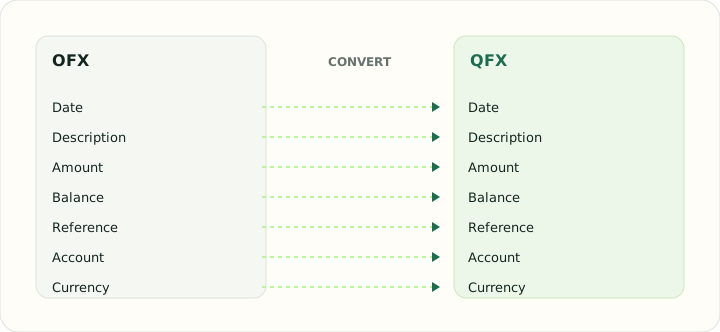
Every transaction element is identical in both formats. The table shows what is copied and what the Quicken header adds.
| Field | In OFX | In QFX |
|---|---|---|
| Date | DTPOSTED in YYYYMMDD form | DTPOSTED timestamp, date part used |
| Description | NAME and MEMO elements | NAME holds the payee, MEMO the longer text |
| Amount | Signed TRNAMT | Signed TRNAMT value |
| Balance | LEDGERBAL block at statement close | LEDGERBAL as of the download date |
| Reference | FITID unique ID plus CHECKNUM | FITID from the bank, CHECKNUM for checks |
| Account | BANKACCTFROM with routing and account IDs | Account block with Quicken's INTU.BID institution ID |
| Currency | CURDEF element | CURDEF code |
Converting OFX to QFX in practice
Turning a generic OFX into Quicken's Web Connect flavour
QFX is Quicken's branded OFX. The transaction data is identical; what Quicken checks for is the INTU.BID institution identifier and, for some versions, an INTU.USERID. The converter leaves the STMTTRN blocks untouched, inserts those elements, and writes the file with the header Quicken expects, so the import behaves like a Web Connect download from a supported bank.
Quicken can be picky about the OFX version declared in the header and about line endings. The output uses the SGML-style header with CRLF line endings that all Quicken releases accept, even when the source was OFX 2 XML.
After converting, check that:
- Quicken imported without an 'unsupported financial institution' message
- Every transaction from the OFX appears in the register
- Amounts and dates are unchanged from the source
How to convert OFX to QFX in three steps
- 1Upload the OFXAdd the generic download Quicken would not accept.
- 2Confirm the account typeCheck that the type is one Quicken supports.
- 3Download and import into QuickenOpen the QFX in Quicken and link it to the account when prompted.
About OFX and QFX
OFX is the standard behind bank downloads. Banks produce it in SGML or XML form, with account and transaction blocks that Quicken can read once the header satisfies it.
QFX is that same content with Quicken's institution elements. Quicken uses them to accept the file and the transaction identifiers to prevent duplicates.
Specifications and vendor help for OFX and QFX: Financial Data Exchange, maintainer of the OFX standard · Quicken support
Questions about QFX conversion
Why does Quicken reject my bank's OFX?
It looks for INTU elements in the header. Once they are present the transactions import normally.
Will anything about the transactions change?
No. Identifiers, dates, amounts and memos are byte-for-byte the same.
Which Quicken versions accept the output?
All Web Connect capable releases, on Windows and Mac.
Can I convert investment OFX files?
Only banking and credit card statements are supported.
Is the ofx to qfx converter free?
Yes. Converting the OFX and downloading the QFX for Quicken is free.